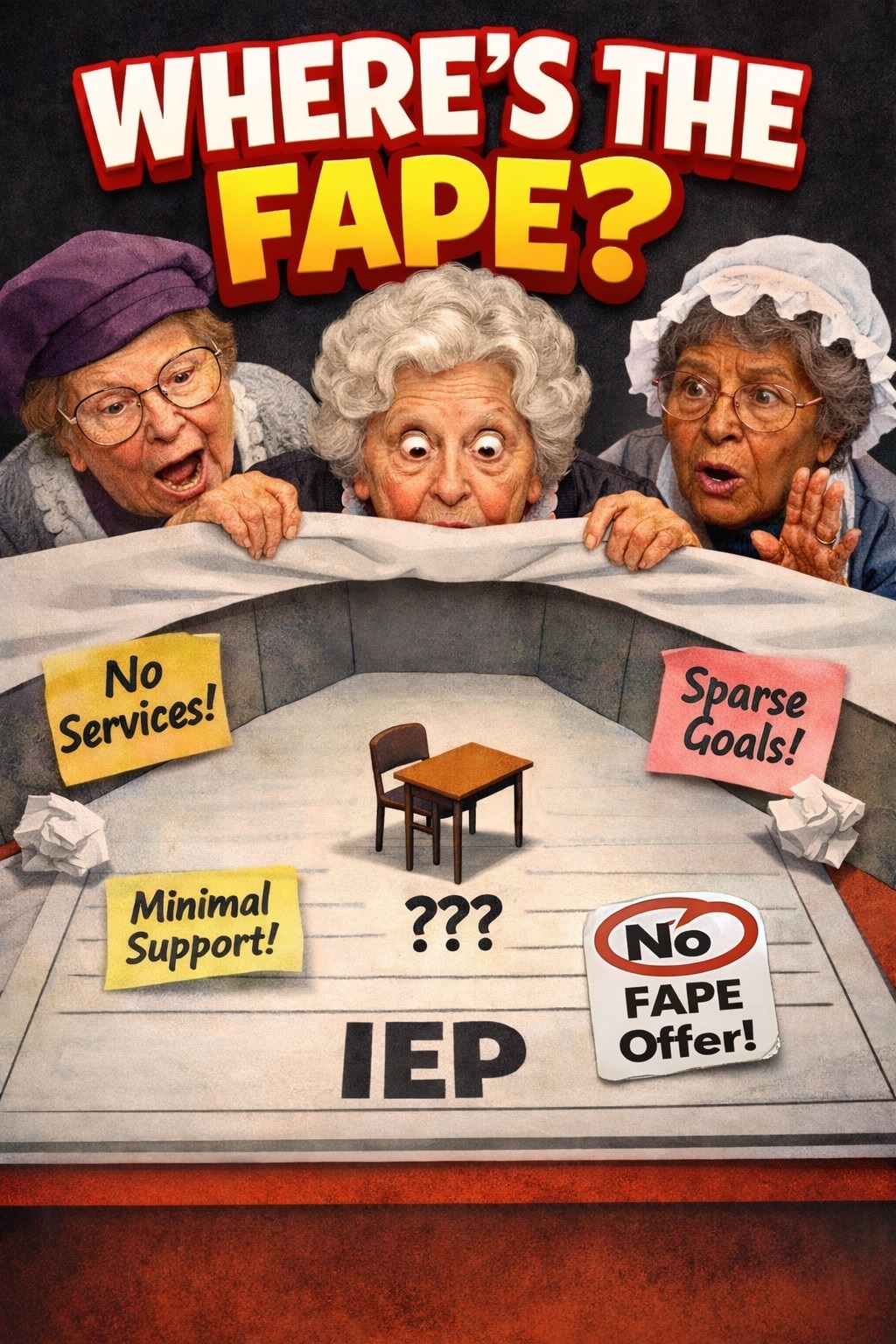
Remember the old “Where’s the beef?” fast-food commercial—the one with the quaint elderly ladies peering into a giant bun, searching for a tiny hamburger? It was adorable. But what we’re now seeing at ADAMS ESQ is anything but cute: real special education services are shrinking and, in some cases, disappearing—camouflaged inside bloated, confusing IEPs. And the children with disabilities who need those placements and services are the ones paying the price.
The Individuals with Disabilities Education Act (IDEA), 20 U.S.C. §1400 et seq. guarantees qualifying children with disabilities the right to a free, appropriate, public education (FAPE). But, the scarcity of qualified special education teachers, service providers, and aides, combined with the absence of meaningful federal guidance and a growing number of children with disabilities, is producing an alarming result: fewer real services, inappropriate placements, rising expulsions, and worse educational outcomes for our most vulnerable students. That leaves us asking: “Where’s the FAPE?”
The Disappearing RSP Class
Not too long ago, children with common learning disabilities like dyslexia or auditory processing disorder received what’s called “pull-out” specialized academic instruction—known as RSP (Resource Specialist Program) services. A credentialed special education teacher would pull a small group of kids into a separate classroom for part of the day and provide focused, targeted instruction.
Those RSP classes are rapidly disappearing. In their place, school districts are offering what they call “collaborative” education models—where special education and general education teachers supposedly work side-by-side in the same classroom. The problem? IEPs under this model often don’t tell you who is teaching your child—is it the general ed teacher? The special ed teacher? An aide? An intern? Nobody knows, (or at least nobody will tell parents).
For a child with dyslexia for example, this matters enormously. Research is clear that children with dyslexia need structured, systematic, evidence-based reading instruction—a specific teaching modality that matches how their brains process language. If the IEP doesn’t say what method is being used or who’s doing the teaching, there’s no way to know whether your child is truly getting what they need.
Generic SAI: When More Hours = Less Help
Specialized Academic Instruction (SAI) is also becoming worryingly generic. Some IEPs include more SAI hours than before—which sounds like a win. But quantity without quality is meaningless. If SAI doesn’t target your child’s specific needs—whether that’s phonemic awareness, reading fluency, math facts, or executive functioning—more hours of the wrong kind of instruction is unlikely to result in educational progress.
In some school districts, the situation is even bleaker: we’re hearing parents told directly, “Your child may need RSP and specialized math instruction, but we don’t offer that here.” Perhaps even worse, parents report to us that even special day classes (SDCs) are being eliminated or staffed with untrained, non-credentialed teachers or subs. After the apparent abandonment of federal special education oversight, some school districts have simply stopped complying with the IDEA’s educational mandates and no longer offer a FAPE for children who need these placements and services.
Charter Schools: All Bun, No Burger?
Families are increasingly turning to charter schools hoping for more individualized support. And while some charters can do a good job for some students, others present serious obstacles.
Virtual charter schools, for example, can be extremely challenging for students with ADHD, autism, or sensory or vision disabilities. The structure (or lack of it) and isolation in an online learning environment can lead to social, emotional and academic regression according to parent reports.
Even more alarming: we’ve seen some charter schools boldly—and illegally—require parents to waive their child’s right to special education altogether as a condition of enrollment. When parents sign away those rights without understanding what they’re giving up, they lose not just the services themselves, but also the IDEA’s powerful protections and procedural safeguards.
The 85-Page IEP: More Fluff, Less FAPE
Strangely, while real services are decreasing, IEPs are getting longer. We’ve seen IEPs topping 85 pages. Yikes! A thick document feels reassuring—until you realize it’s stuffed with boilerplate language, recycled data from prior years, and sometimes information that refers to a different child altogether. Pro tip: the length of an average IEP is 25 pages. Initial IEPs and triennial reviews may be a little longer since they can include more data. IEP “Amendments” and “Addendums” should only run 2-3 pages long.
Under 9th Circuit law—which covers California and Nevada—a school district (or charter school) must make a “formal, specific offer” of FAPE in writing. Union Sch. Dist. v. Smith, 15 F.3d 1519 (9th Cir. 1994). But instead of making a clear, written offer, many districts and charters are now running never-ending IEP meetings that stretch for years—always in process, never actually producing a real offer of services. A meeting that never results in a clear FAPE offer isn’t an IEP process. It’s a stall tactic.
Finding FAPE: What Parents Can Do Right Now
1. Demand a clear, written FAPE offer at every IEP meeting. You are entitled to know: exactly what services your child will receive, how often (not just minutes per year—ask for a weekly or at least monthly breakdown), where services will take place (e.g. push-in, pull-out, small group, 1:1, etc.) and who will be providing them. You should never leave an IEP meeting wondering what your child’s school day is going to look like.
2. Record your IEP meetings. Most IEP meetings are now held via Zoom. At least 24 hours before the meeting, submit a written request that it be recorded and that you receive a transcript. A recording creates an unambiguous record of what was—and wasn’t—offered.
3. Watch out for vague “collaborative” service language. If your child’s IEP describes services without identifying who is providing them or what method is being used, push back. Vague language isn’t just unhelpful—it can signal that no qualified staff member has analyzed your child’s unique needs and how to address them.
4. Don’t waive your child’s right to a FAPE. Any charter school or school district that pressures you to waive your child’s crucial special education protections and services may be acting illegally. Contact an attorney before signing away these important rights.
5. If you haven’t gotten a real offer after multiple meetings, that’s a red flag. An IEP process that drags on for months—or years—without ever producing a clear, written FAPE offer may itself be a denial of FAPE. Document your concerns in writing and consider filing a State Compliance Complaint or consulting a special education attorney.
Your child has a federally protected right to a free, appropriate public education. A confusing, bloated IEP, a charter school that forces you to revoke FAPE, or a school district that keeps postponing real offers doesn’t change that. If you find yourself asking “Where’s the FAPE?” perhaps it’s time to seek legal help.