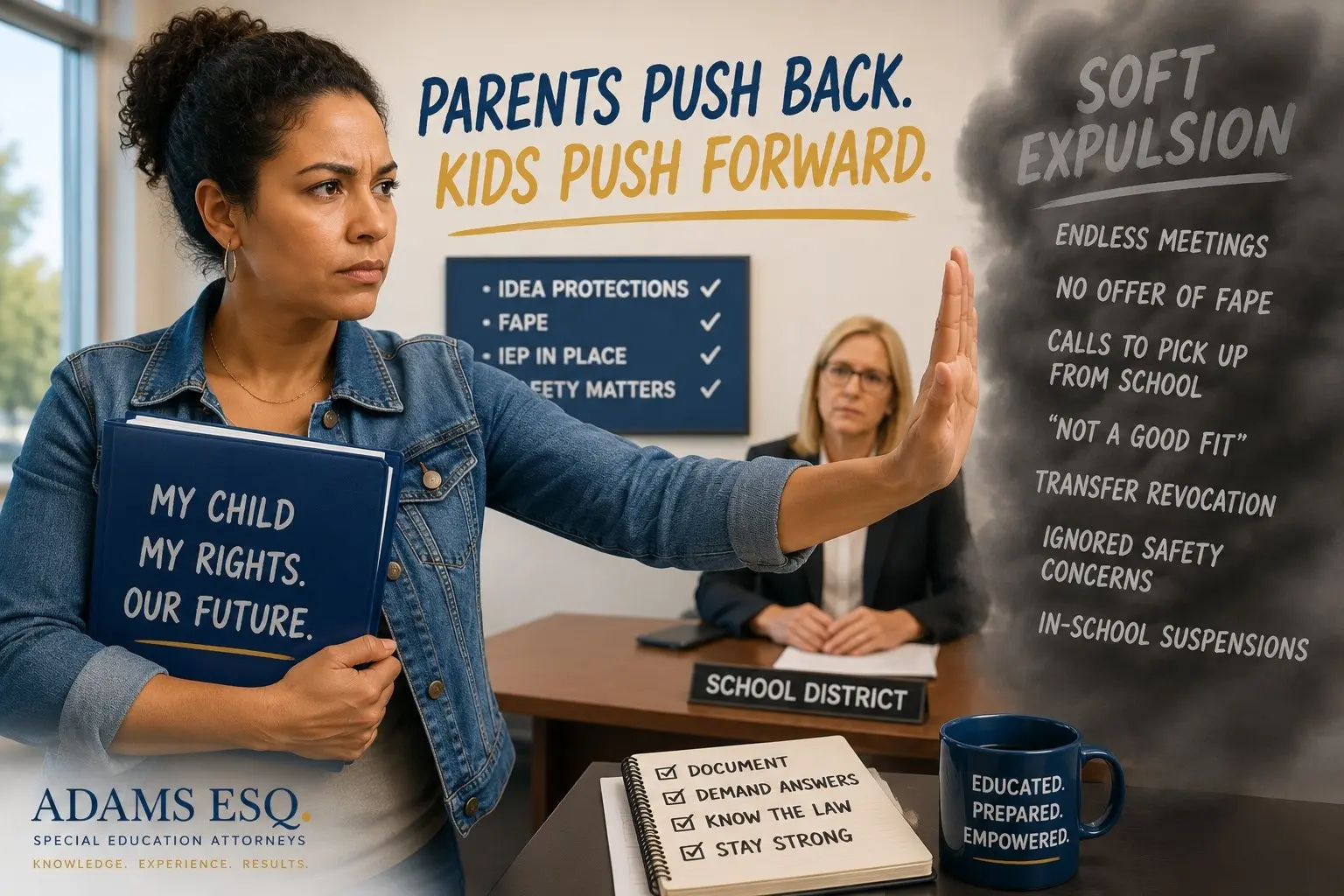
Hard Pushback to Soft Expulsions
By Jean Murrell Adams, Esq. • June 2026
At ADAMS ESQ, we represent families who are fighting hard to get appropriate IEPs for their children with disabilities. Lately, we are seeing a troubling pattern playing out across California and Nevada school districts and charter schools. Families are being pushed out. Not through formal expulsion hearings, manifestation determinations or tactics you could easily point to in writing. You think it’s just happening to your family—but children with disabilities are being systematically removed from special education programming at alarming rates.
We call this a soft expulsion and it is happening–a lot!
What Is a Soft Expulsion?
A soft expulsion is the unofficial removal of a child with a disability from their public school program. Sometimes it looks like a school making attendance so unsafe, so stressful, or so impossible that parents feel they have no choice but to keep their child home — or pay out of pocket for a private placement. No formal hearing. No written order. Just a slow, steady squeeze until the family gives up.
Here’s what soft expulsion can look like:
Never-ending IEP meetings — with no offer of FAPE. The meetings keep getting continued. Months go by. Still no final written offer of services. Your child is left in limbo while the district stalls. Under the law, a district must have an IEP in place for your child at the beginning of each school year. See20 U.S.C. § 1414(d)(2)(A); 34 C.F.R. § 300.323(a); Cal. Ed. Code § 56344(c). Endless continuances are not a neutral inconvenience — they can be a denial of your child’s rights.
Calls to pick your child up from school. You get a call. Then another. Then another. Each time, the school asks you to come get your child early. There is rarely anything in writing. But the message is clear: your child is not welcome here.
Charter schools saying your child is “not a good fit.” Charter schools are public schools. They are required to serve children with disabilities under the IDEA. “Not a good fit” is not a legal standard, it’s a soft expulsion.
Revocation of inter-district transfers. Inter-district transfer agreements allow your child to attend school outside your home district. But they can be revoked more easily than many families realize. A revocation at the wrong time can leave your child without an appropriate educational program.
In-school suspensions (ISS). One or two days of ISS might not raise a red flag. But repeated, extended in-school suspensions where your child is pulled from instruction and left to sit in an office, can add up to a serious loss of education and, in some cases, trigger IDEA protections. See 20 U.S.C. § 1415(k).
Ignoring parent safety concerns. You have told the school that your child is not safe. Sometimes it’s from repeated bullying, elopement or self-harm. You have said it in writing. You have said it in IEP meetings. The school team says it wants to help—but nothing actually gets done. Meanwhile, your child comes home scared, hurt, or refusing to go back.
Your Child Has Legal Protections. Use Them.
Here is what many families do not know: the IDEA prohibits schools from expelling students with disabilities for conduct related to their disability. See 20 U.S.C. § 1415(k). That protection extends to the formal expulsion process. But the law does not give families an easy tool to stop informal, soft pushouts which may be why schools use them.
Parents and caregivers must push back hard!
How to Push Back Hard Against Soft Expulsion
These are your tax dollars. Your child has a legal right to a free, appropriate public education. Here is what you can do right now:
- Avoid the ISP trap.Some families are approached about an Individual Service Plan (ISP) — an agreement that provides minimal school services at home but strips your child of IDEA protections. An ISP is not an IEP. It does not carry the same legal weight. Do not agree to an ISP if your child is eligible for special education under the IDEA. You could be exchanging your child’s rights for much weaker services.
- Demand a written offer of FAPE — or a Prior Written Notice explaining why one is not forthcoming.If your child’s IEP process has been dragging on without resolution, put your request in writing: you want either a final written IEP offer of FAPE, or a Prior Written Notice (PWN) documenting why the district is declining to make one. Federal and California law require that an IEP be in place at the start of each school year. See20 U.S.C. § 1414(d)(2)(A); 34 C.F.R. § 300.323(a); Cal. Ed. Code § 56344(c). Districts cannot simply run out the clock and say, “see you in September.”
- Keep a log of every call to pick up your child.Every single time the school calls to ask you to pick up your child, write it down: the date, the time, who called, and the reason given. These calls are rarely random. When documented, they tell a story — and that story can be powerful evidence in a due process case.
- Do not agree to waive IDEA protections as a condition of charter school enrollment.Some charter schools present enrollment agreements that effectively ask families to accept reduced special education rights. You do not have to sign away your child’s IDEA protections to enroll in a charter school. Charter schools that receive public funding are subject to the IDEA. See20 U.S.C. § 1413(a)(5); Cal. Ed. Code § 47646.
- Understand that inter-district transfers can be revoked.If your child attends school in another district under a transfer agreement, be aware that those agreements are not guaranteed. Revocation is sometimes used as a soft expulsion tool — particularly where a student’s needs are seen as expensive or disruptive. Know the terms of your transfer agreement and document any conversations about your child’s program at the receiving district.
- Don’t wait for the school to write the safety plan — present it yourself.If your child is not safe at school and the district is not acting, work with your child’s physician, therapist, or other treating professionals to develop a safety plan. Put it in writing. Then send it to the school and demand that it be incorporated into your child’s IEP. The school cannot simply ignore a safety plan developed with your child’s medical team.
- Call a lawyer.If you are seeing any of the patterns described above or otherwise suspect soft expulsion, please do not wait and hope things get better. Hope is not a strategy! Special education attorneys can offer case evaluations, file a due process complaint, or negotiate a placement — often at no cost to qualifying families.
The Bottom Line
Soft expulsion is real, it is happening, and it is wrong. But it works best when families don’t recognize it for what it is or don’t know they have the right to fight back.
You do.
If your child is being pushed out of their school program through any of these tactics, ADAMS ESQ wants to hear from you. Visit AdamsEsq.com to request a free case evaluation. Our attorneys represent families in California and Nevada — and in most cases, qualifying families pay nothing out of pocket.
Your child belongs in school. Let’s make sure they get to stay there.
Disclaimer: The information in this blog does not constitute legal advice. Facts and law differ in every case. Please consult an experienced special education attorney before acting on any information in this post.
Share on social media — you may help a family who doesn’t know their child has rights.