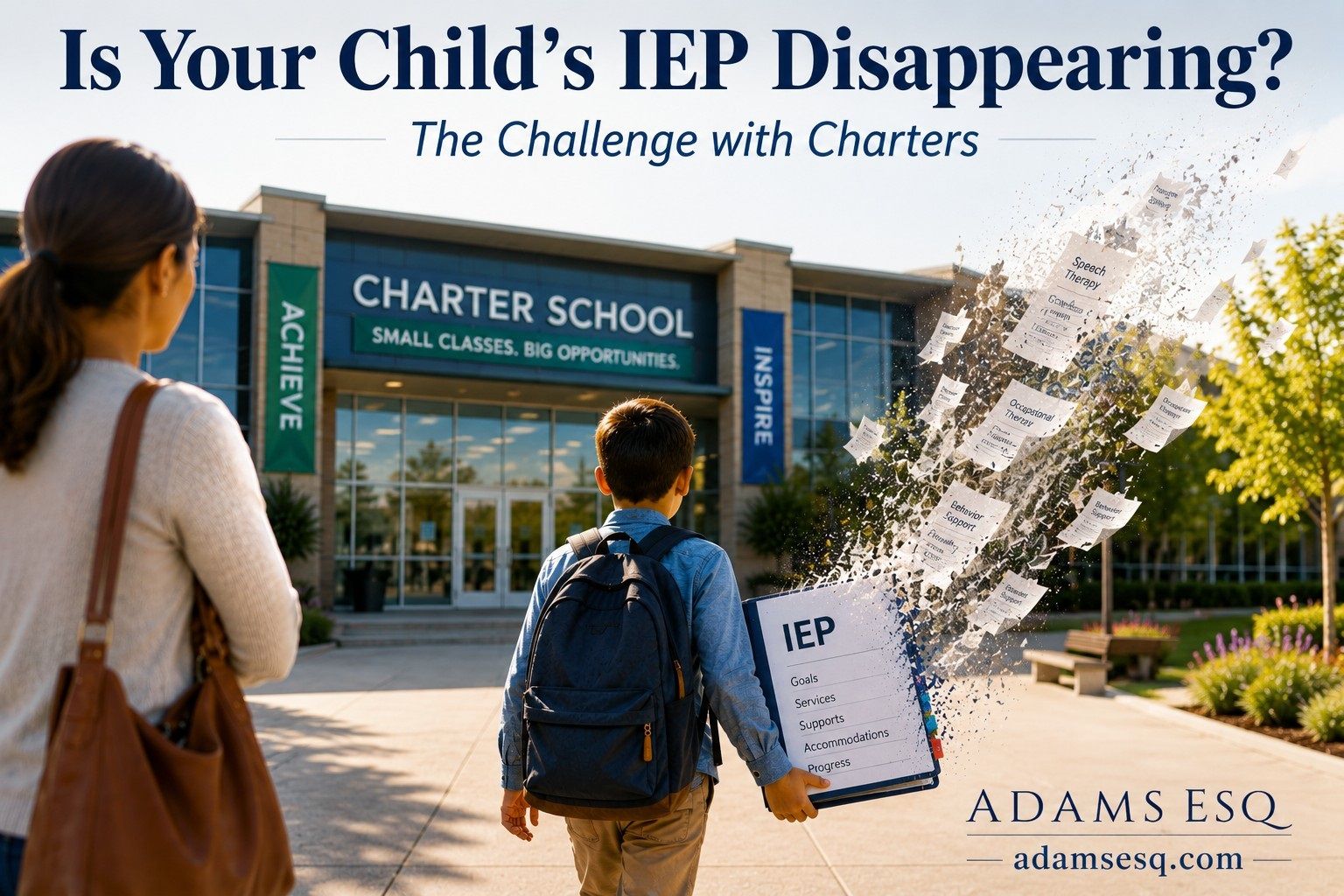
Part One: In-person Charter Schools and Disappearing IEPs
Jean Murrell Adams, Esq.
July 2026
When parents of children with IEPs choose a charter school, they’re looking for a better education for their child. Smaller classes, a safer environment, more individual attention and a fresh start. Many parents find exactly that. But others discover something they never expected: their child’s IEP slowly begins to disappear. At ADAMS ESQ, we represent families across California and Nevada who are fighting to get appropriate education and services for their children with IEPs. This year, more and more of those calls are about one place: charter schools. So many, in fact, that we are splitting this blog into two parts. This month we look at brick-and-mortar charters. Next month we take on virtual charters, which have earned a post all their own.
There’s Space in the Pool for Everyone
Charter schools are not the enemy. For some children with IEPs, a charter can be a good option. Smaller class sizes can mean a child is seen and heard. Flexible scheduling can provide important opportunities for inclusion for a medically fragile child. A short stint in a charter may help a child who otherwise would face expulsion from their public school.
Most parents don’t enroll because they’re chasing test scores. They’re looking for hope. Maybe the neighborhood school wasn’t working or bullying became unbearable. Maybe someone promised that a smaller campus would finally understand autism, ADHD, dyslexia or emotional disabilities. Those hopes are understandable. But hope alone doesn’t implement an IEP.
What Parents Are Telling Us
After reviewing dozens of charter school consultations over the past year, five patterns came up again and again.
1. The IEP that works on paper and nowhere else.
One mother put it best:
“I feel his IEP looks great on paper but bombs out in application. I need help to get them to really help, not just have a nice looking IEP on paper.”
If you’ve ever found yourself reteaching your child’s lessons or completing their homework every night, you’re not alone. Another parent described a middle schooler with a learning disorder placed in Algebra and Spanish with only a half hour of special education support per week, from a teacher who told her that her son “is just being bad and not listening.”
Once an IEP is in place, the school must make FAPE available and implement it as written. See 34 C.F.R. §§ 300.101, 300.323(c)(2). Related services like speech, occupational therapy, physical therapy, assistive technology, counseling, transportation, nursing and more, are part of that obligation, not optional add-ons. See 20 U.S.C. § 1401(26). Minutes that quietly disappear when a provider resigns and is never replaced are not a staffing inconvenience. They are a denial of FAPE, and they are compensable.
2. Assessments that never get finished.
This was the single most common complaint in our file, and it is the one parents are least likely to recognize as a legal violation.
One family’s triennial assessments began in September and, seven months later, still had not made it to a completed IEP meeting. During those seven months, the child kept attending the same classes while waiting for evaluations everyone agreed were overdue.
Another parent requested evaluations in February and watched the school do nothing until the following October when she was told the assessment plan she had already signed was the “wrong form,” which conveniently restarted the clock. When she arrived for the eligibility meeting, she was told that the meeting was cancelled. She never received prior written notice. She never received the assessment reports.
A third parent explained what delay actually costs. Had her son’s triennial (3-year review) been completed on time, he would not have been misplaced in classes far beyond what he could manage, he would have qualified for regional center services two years sooner, and he may not have started self-medicating to cope with feeling overwhelmed at school.
IEP timelines are important. In California, the charter school must give you a proposed assessment plan within 15 days of your written referral, see Cal. Ed. Code § 56321(a), and must hold the IEP meeting within 60 days of receiving your signed consent. See Cal. Ed. Code § 56344(a); 34 C.F.R. § 300.301(c)(1). Reevaluations must occur at least once every three years. See 20 U.S.C. § 1414(a)(2)(B)(ii); 34 C.F.R. § 300.303(b)(2). And when a school refuses or delays, it owes you prior written notice explaining why. See 20 U.S.C. § 1415(b)(3); 34 C.F.R. § 300.503. “We’re still working on it” is not prior written notice.
Pro tip: remember that your right to a school-funded Independent Educational Evaluation (a second opinion) usually doesn’t kick in until the charter’s assessment is completed. So delayed testing also impacts this important parent right!
3. Safety—including restraint you never hear about.
Parents describe elopement from unsecured campuses, one-to-one aides who exist on paper but are routinely shared among several children, and students parked by the front doors of the school where they can walk straight out. One mother told us her daughter had never eloped anywhere in her life until she enrolled at a charter that admittedly failed to follow her behavior intervention plan.
Perhaps the toughest consultation came from a mother who learned about restraint from her son, not from his school:
“He told me his arms had been held down at least four times that day and it hurt. Nobody from the school called me. Not once.”
Both states regulate this. In California, restraint and seclusion may be used only to control behavior posing a clear and present danger of serious physical harm that cannot be prevented by a less restrictive response, and may never be used for coercion, discipline, convenience, or retaliation. Locked seclusion is prohibited. See Cal. Ed. Code §§ 49005.4, 49005.8. In Nevada, when physical restraint is used on a student with a disability in an emergency, it must be documented within one working day and a copy of that report must go to the IEP team and to the parent. Three reports in one school year trigger a review; five require the IEP itself to be reviewed. See Nev. Rev. Stat. § 388.501(3)–(5).
If your child is being restrained and you are only hearing about it from your child, the school is out of compliance. Ask for the reports, in writing.
And when behavior is the issue, the IEP team is required to consider positive behavioral interventions and supports. See 20 U.S.C. § 1414(d)(3)(B)(i); 34 C.F.R. § 300.324(a)(2)(i). “We’re a small school and we don’t really do behavior plans” is not an answer. It is an admission.
4. Noncredentialed staff, untrained aides and administrators who don’t know the law.
Imagine learning that your child’s pediatrician wasn’t qualified to diagnose children or her therapist wasn’t licensed. Special education credentials matter for the same reason.
Parents describe specialized academic instruction delivered by someone with no special education credential, and untrained aides sent to a family’s home to deliver what the school called extended school year services. Many parents report that related services like speech and OT aren’t delivered at all.
In California, charter school teachers must hold the same certification documents required of teachers in non-charter public schools. See Cal. Ed. Code § 47605(l). The old flexibility for non-core courses expired July 1, 2025. In Nevada, a teacher employed by a charter school to teach special education must be licensed to teach special education. See Nev. Rev. Stat. § 388A.518.
Equally troubling is what parents describe from school administrators. A principal who says the school “doesn’t take IEP students.” An enrollment clerk who asks for the IEP before the child is admitted. A director who explains that your child is “not a good fit,” or that the district can serve him better. A team that has never heard of prior written notice. Creation of “Frankenstein” IEPs. Sometimes this is bad faith. Often it is a small organization with a thin back office and improper IDEA training. Either way, the result for your child is identical.
5. Push-out—and what happens to parents who complain.
A Nevada mother of a non-verbal nine-year-old explained that the charter school claimed her son wasn’t learning because he had no language. Then, after years of attendance, the principal proposed cutting his class time down to one day a week, or to half days—clearly, the principal simply wanted him gone.
Another mother of a kindergartner was called to pick him up almost every other day, sometimes ten minutes after drop-off. She was told she needed to volunteer two or three days a week for him to attend at all. Then the school threatened her with truancy—for absences the school itself created.
This is what we called a soft expulsion in last month’s post, and it is alive and well in the charter sector. A shortened school day is not a scheduling favor. It is a change in placement.
Two other patterns deserve mention, because parents rarely see them coming. One family was disenrolled from a charter after the mother repeatedly complained that no speech therapist was showing up—and then received a letter from the school’s attorney telling her to stop. And in two separate matters, a call to child protective services followed shortly after a parent pushed hard for services. Both were resolved as unfounded. Faced with this intimidation, parents are thinking twice about voicing their complaints.
Caution: we are relaying what families report to us, not proven facts. But if you are afraid to advocate for your child because of what the school might do to you, that fear is itself worth reaching out to a lawyer.
Can a Charter School Refuse a Student with an IEP?
Remember, charter schools ARE public schools. A charter may look and operate like a private school, but it is still a public school. It does not get to accept public funding while treating your child’s IEP as optional:
- Children with disabilities who attend charter schools, and their parents, retain all rights and protections under the IDEA, exactly as they would in any other public school. See 34 C.F.R. § 300.209(a); U.S. Dep’t of Educ., Off. of Special Educ. & Rehab. Servs., Frequently Asked Questions About the Rights of Students with Disabilities in Public Charter Schools Under the IDEA (Dec. 27, 2016).
- In California, a charter school may not discriminate against a student on the basis of disability and must admit all pupils who wish to attend, subject only to a public random drawing. See Cal. Ed. Code § 47605(e)(1), (e)(2)(A). Enrollment may not be denied because the charter does not have a program in place for your child. See 34 C.F.R. § 104.4(b)(3); Cal. Ed. Code § 47646(a).
- In Nevada, discrimination in charter school admission is prohibited, see Nev. Rev. Stat. § 388A.453, and a charter school may not require a family to hand over an IEP as a condition of applying, before the student has accepted admission. See Nev. Admin. Code § 388A.538(1)(e).
“Not a good fit” is not a legal standard. The law asks whether the school can provide FAPE, not whether serving your child is convenient.
What You Can Do Right Now
- Get the offer in writing before you enroll. Ask the charter, by email, exactly how it will implement each service and each minute in your child’s current IEP. Save the reply. If there is no reply, save that too.
- Before enrolling, ask to meet the special education teacher, not just admissions.
- Find out who your local educational agency (LEA) is—before you need to know. In California, a charter is either its own local educational agency within a SELPA or a school of the district that authorized it. See Cal. Ed. Code § 47641. In Nevada, most charters are sponsored by the State Public Charter School Authority and act as their own LEA. This determines who is legally responsible for FAPE and who you name in a complaint. Families can lose valuable time by complaining to the wrong entity.
- Put every assessment request in writing and calendar the deadline. Write down the date you asked. Then count: 15 days for the assessment plan, 60 days from your signed consent to the IEP meeting. If the school tells you the form was wrong, ask in writing which timeline it believes applies, and why.
- Check teacher credentials. Both Nevada and California list teacher credentials on public websites. Check these sites before you entrust your child’s education to an unqualified teacher. Pro tip: for Nevada parents, click on the name of the charter school in the dropdown menu to see a list of all credentialed teachers.
- Request every restraint report. If you learn your child has been restrained, ask in writing for the written report of each incident, and request both an IEP meeting and a functional behavior assessment.
- Do not accept a shortened day as a solution. Only the IEP team (which includes you) can change your child’s program, and reducing your child’s school day is a change in placement that requires prior written notice.
- Call a lawyer. Do not spend another semester hoping the charter will figure it out.
Hope is not a strategy.
The Bottom Line
Charter schools can absolutely be the right choice. But no child should have to trade individualized supports for a smaller campus, or flexibility for fewer services. A beautiful website, a caring principal, and a smaller classroom do not replace a legally compliant IEP.
Next month: what virtual charters promise, and what they actually deliver.
If your child has an IEP and is enrolled in a charter school and any of this sounds familiar, ADAMS ESQ wants to hear from you. Visit AdamsEsq.com to request a free case evaluation. Our attorneys represent families throughout California and Nevada, and most families qualify for our retainer fee waiver.
Disclaimer: The information in this blog does not constitute legal advice. Facts and law differ in every case. Please consult an experienced special education attorney before acting on any information in this post.
Share on social media—you may help a family who doesn’t know their child has rights.